About
About

Annika Roy is an art conservator specializing in paintings and gilded wood. She is a graduate of the Institut national du patrimoine (Paris, 2020), where she obtained a master’s degree in Conservation–Restoration of Cultural Heritage, awarded with distinction and the congratulations of the jury. She also holds a bachelor’s degree in Art history and Archaeology from the University of Aix-Marseille.
She works for public cultural institutions — including museums, historic monuments, and local authorities — as well as for private collectors. Her studio is based in Semur-en-Auxois (Burgundy). She works throughout France, particularly in Paris, and internationally, notably in the Netherlands.
Annika Roy is a member of the International Concil of Museum (ICOM), the French Federation for Conservators (FFCR) and Restauratoren Nederland (RN). She is fluent in French, English and Dutch.
Ethics
Her professional practice complies with international conservation standards and follows the ethical guidelines set out in the Code of Ethics of the European Confederation of Conservators Organisations (E.C.C.O., 2002).
In particular, her work is guided by the principles of:
- Stability of the materials and products used on artworks.
- Compatibility between conservation materials and the object.
- Reversibility oof treatments: all added materials must be removable without damaging the artwork.
- Discernibility: interventions must remain identifiable to the trained eye upon close examination, while respecting the aesthetic integrity of the work.
Methodology
Each conservation project begins with a detailed condition assessment, including a diagnosis of the artwork’s state of preservation. This assessment leads to a tailored treatment proposal, validated in consultation with the collection manager or owner.
An intervention protocol is then developed, based on professional expertise and preliminary tests, in order to determine the most appropriate conservation solutions.
All projects are rigorously documented through a comprehensive written report and a photographic campaign carried out before, during, and after treatment.
As each artwork is unique, every project involves prior examination and discussion with the owner to establish expectations and provide a customized proposal.
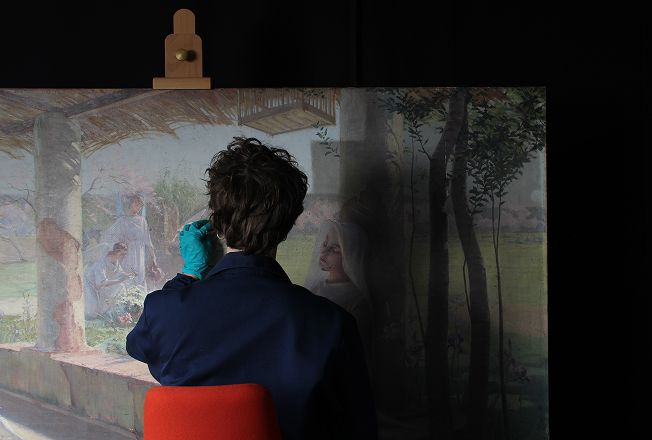 Edouard Paupion, Le Sommeil de la Vierge, 1896, huile sur toile, Dijon, Musée d’Art Sacré
 Panoptique d’Autun – musée Rolin